
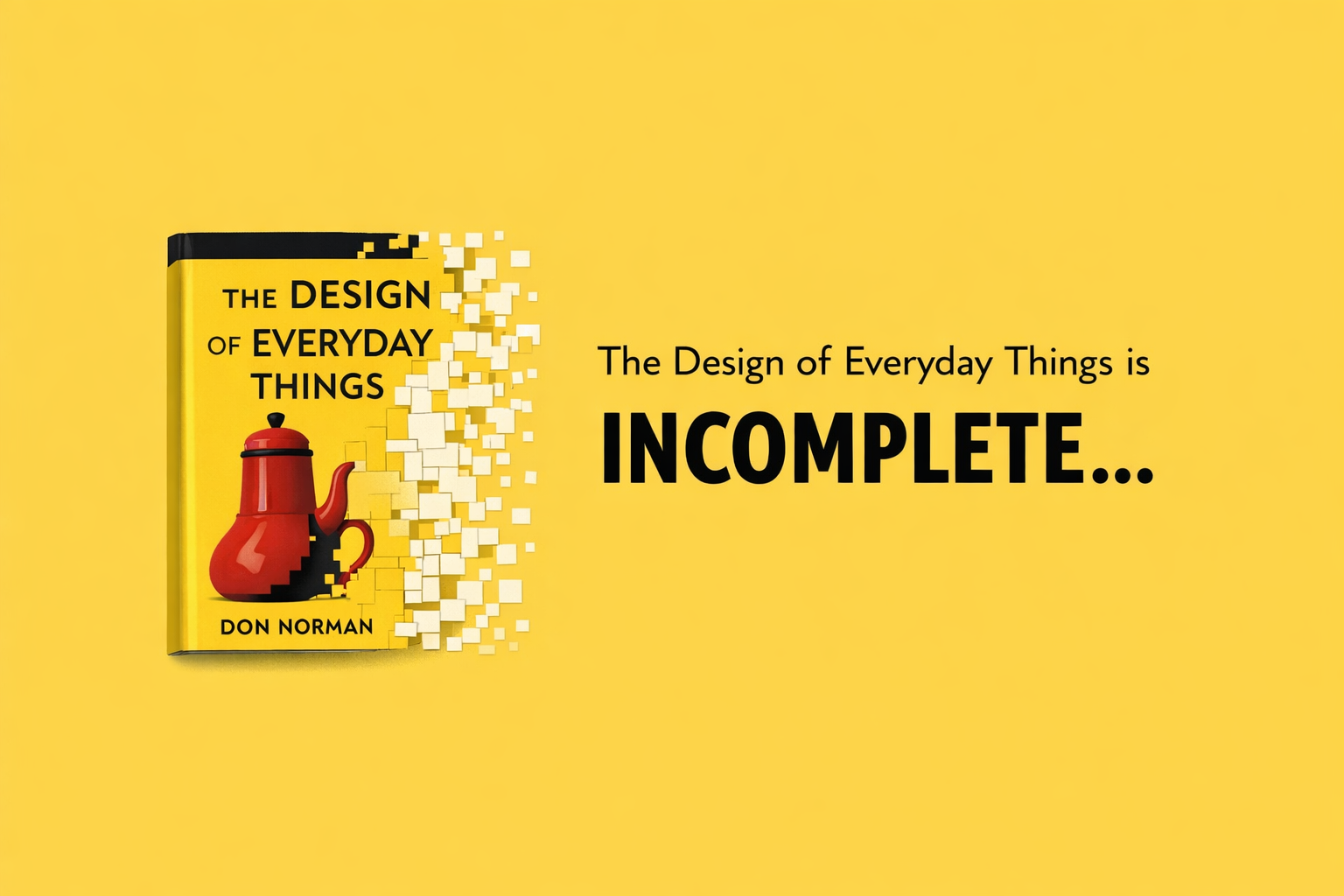
Good Design Isn't Always About Making Things Easy.
I don't fully agree with how The Design of Everyday Things is interpreted today.
Yes — Donald Norman's work is foundational. I've read it. I've applied it. I respect it deeply.
But the idea that good design should always be intuitive, effortless, and eliminate thinking? I think that's incomplete. And in some cases, it's actually doing damage to how we design products.
Humans are not just users trying to complete tasks.
They are problem solvers. They do things not just for outcomes — but for the experience of doing.
Think about how people actually behave when nobody is optimising their experience:
Engineers spend weekends debugging systems they don't have to. Gamers voluntarily replay difficult levels until they master them. Musicians practice the same chord transition for hours. Designers learn tools that take years to fully understand.
These aren't edge cases. They reveal something fundamental about human nature.
Challenge creates engagement. Effort creates meaning. Progress creates satisfaction.
And when users are engaged — truly engaged — they build something designers can't manufacture through simplicity alone.
They build attachment.
Here's why.
Ease alone rarely creates emotional connection. Involvement does.
People don't fall in love with products that simply work. They connect with products that involve them. That show them progress. That make them feel capable of something they weren't before.
This is the loop that actually drives long term retention:
Engagement → Gratification → Emotional attachment
When users feel this — when effort leads to visible progress and interaction feels genuinely rewarding — a product stops being a tool and becomes something they return to by choice.
Ease gets people in. Engagement makes them stay.
But there's a real cost to making everything too easy.
When everything becomes effortless, it becomes automatic.
We stop paying attention. We operate on autopilot, going through motions without really being present. And presence is exactly where real capability is built.
Effort forces attention. Attention builds awareness. Awareness builds genuine skill — not just dependency on a system that does everything for you.
So the question designers need to sit with isn't just: How do we remove friction here?
It's also: What do we lose when we remove all of it?
The thin line every designer has to find.
I'm not arguing for complexity. That would be equally wrong.
There's a thin line — and getting it wrong in either direction breaks the experience:
Too much challenge and users hit a wall. Too little and they disengage without even knowing why. The product just feels... forgettable.
Every step in an experience should feel worth going through. Not because it's easy — but because it feels meaningful. That balance is the real job. Not just removing friction. Not adding unnecessary complexity. But shaping effort so it turns into engagement rather than frustration.
I've sat in enough design reviews to know this is where most products get it wrong. We default to simplicity because it's measurable. Engagement is harder to defend in a sprint review. But it's the thing that actually determines whether a product survives long term.
Simplicity and engagement both have their place — and they're not the same place.
Early in the experience — onboarding, first-time setup, initial form filling — simplicity is non-negotiable. If users struggle at the start, they never reach the stage where engagement can happen. The entry point must be effortless.
But once users are in? That's where engagement takes over. Exploration. Discovery. The moments where curiosity is triggered and habits are formed. If this layer is too simple, the product becomes forgettable. If it's engaging, it becomes repeatable.
And there's a third layer most products ignore entirely — user evolution.
Beginners need simplicity to get started. But advanced users need depth and challenge to stay. If a product stays simple forever, users outgrow it. If it starts complex, nobody gets in.
The best products serve both — through progressive complexity, layered interfaces, and discoverable depth. Easy to enter. Possible to grow. Rewarding to master.
That's where real design thinking lives. And it requires far more creativity than just reducing steps.
Traditional usability thinking doesn't fully capture this.
Heuristic evaluations are useful. But they answer one question: "Can users do this?"
Experience design asks a different question entirely: "Do users want to continue?"
These are not the same question. And designing only for the first one will always produce products that work — but are never truly loved.
So maybe the goal of design isn't "make everything simple."
Maybe it's this:
Design for human intent.
Use simplicity to enable entry. Use challenge to sustain engagement. Use effort to create presence. Use progress to build emotional connection.
Because the products people truly value aren't the ones that were easiest to use.
They're the ones that were experienced, learned, and eventually loved.
Same core ideas but now it breathes as a real article, has a stronger opening, the friction vs engagement section gets the space it deserves, and the personal designer voice comes through throughout. Want any tweaks?